


Nike Japan designed a special gift to honor Rafa's recent successes and his inaugural trip to Japan. The one-of-a-kind hoodie was inspired by a traditional Japanese jacket called "Suka-Jan," famous for beautiful embroideries that cover the back. Check out the album see the story behind the design.

The peony, hand-embroidered in gold thread, that adorns the hood of the jacket represents Rafa's current status as "King" or Number 1 in tennis.

The four Japanese characters on the back spell out "Raging Bull Attack" - the two on the left for "Raging Bull," from his nickname, and the two on the right making up a common word historically used when outsiders would attack Japan. It symbolizes Rafa's historical first visit to the country and the world-class level of physical and mental "attack" he brings to the game of tennis.
Below the Japanese characters is an unmistakable icon of Japan: the sun rising through the clouds above Mount Fuji. It is included as a beautiful reminder of the country.
The "Raging Bull" sits just below Mt. Fuji, adorned in red and purple peonies, with red representing the national color of Japan and purple nobility.

Here's an up close look at the face of "Raging Bull" and White Snake. The face design was inspired by a Japanese traditional celebration icon called "Shishi-mai" or "Lion Dance" which is used only during happy celebrations in Japan.
The White Snake is a symbol of good luck, so by intertwining the Snake (luck) with the Bull (Rafa), they are bringing good luck to him.

Rafa's hoodie is made up of several unique elements, designed in collaboration with one of Japan's most sought-after tattoo artists, AKILLA from Tattoo Soul.
The back features Japanese characters, a rising sun over Mt. Fuji, and the "Raging Bull." The front features the face of "Raging Bull," intertwined with a White Snake and the hood is adorned with a gold embroidered peony. Read on to learn more about each design element.

This is a rendering of the hoodie front, adorned with the face of "Raging Bull" and a White Snake on the right breast.

Rafa's "Raging Bull Attack" hoody was delivered to him in custom designed box and hand-embroidered bag. Recognize the Japanese characters and the flower?
(source)

Rafael Nadal reveals a childhood love of the anime series during the Japan Open tennis tournament while Kei Nishikori is philosophical after his defeats
By Christopher Johnson 8 October, 2010When Rafael Nadal was a young boy on the Spanish island of Majorca, he used to run home from school to watch his favorite Japanese anime -- "Dragon Ball."
The Toei Animation cartoon, adapted from a 1980s manga by Akira Toriyama, must have made an indelible impression on the young Nadal.
Like Dragon Ball’s hero Goku, a martial arts student who came from an extraterrestrial race called Saiyans, Nadal has also come to conquer the world, or at least the tennis world, with an unorthodox style that he seemed to learn on another planet.
In fact, Spanish astronomers have even named an asteroid belt after him.
Dragon Ball inspiration
Rocketing across the court, twisting to hit winners from impossible angles, Nadal sometimes even looks like Goku, with his mouth open in a grunt that is both ugly and sexy for millions of his worldwide fans.
“It’s my favorite cartoon,” Nadal tells journalists in Japan who ask him about "Dragon Ball" after his opening round victory at his first ever Japan Open.
“I have all the DVDs, from the first one to the last one.”
A superhero with a hulking physique and intimidating glare, the feisty Spaniard is more raging bull than matador on the court.
As a Wimbledon commentator once said, Nadal is simply out to beat you on every point.
Islander charm
But off the court, Rafa has a simple islander charm in stark contrast to his friend and arch-rival Roger Federer, the sophisticated and multilingual cultural ambassador who wowed fans at the Japan Open in 2006.
Coming into the Ariake tennis center press room after his first round victory, the 24-year old Nadal, who has won more than $30 million on tour, apologizes like a schoolboy, “Sorry, I was a little bit late.”
He works hard to communicate clearly, and uses new words he has just learned, such as "cartoon."
While the former vegetarian Federer talked about Zen philosophy, Japanese proverbs, and playing tennis at the Imperial Palace, Nadal says stuff like “I don’t like shopping.”
On his off-day Wednesday, he played a few holes of golf but otherwise hung around the hotel trying to rest from a relentless year of touring which saw him win the French, Wimbledon and U.S. titles.
“Japan is one of the places you definitely want to know and hopefully I will be able to come back. The Japanese people are giving me a lot of presents. I’m just enjoying these days, on this very nice center court atmosphere,” he says.
Fan adoration
For tennis fans, who consider the Nadal-Federer rivalry to be among the greatest ever in sports, it’s amazing to hear Nadal say he doesn’t know if Federer is currently ranked number two or number three.
"It's very difficult to always be at the top," he says of Federer.
"What he did is very, very difficult. For me, I don’t think there’s a big difference being number one or number two in the world. My life doesn’t change. I’m still with my family at home. It’s a really normal life for me," he says.
"The best thing is not being number one in the world, it’s being healthy and being able to enjoy my life,” he adds.

Found this documentary on Rafa that seems to have aired on Japanese television before or during the Japan Open. It is in Spanish and Japanese but is very nicely edited so it is not too difficult to follow. Enjoy!
Translations provided by" Kuuchuu Sampo
Translations here:
Male Narrator: The man who holds the No. 1 ranking in men's tennis, with a body like steel and an inimitable extreme playing style: Rafael Nadal, age 24. By winning the US Open this year, he achieved a Career Grand Slam. For this man who at a young age grabbed glory and honed his mental strength, technique, and physique, there was a large obstacle. This is the world's first in-depth documentary on Nadal. A Man of the Sun: Rafael Nadal. The Origins of the No. 1 Tennis Player in the World.
Female Narrator: Spain, Majorca. He was born and continues to live on this island. Ranked No. 1 in the world, Rafael Nadal created history in 2010.
(US Open)
Male Commentator: He has etched his name into a new history! Rafael Nadal!
Female Narrator: September 13, his first US Open victory. Winning all four Grand Slams, he accomplished a Career Grand Slam. His daily life is certainly amazing. Despite being a champion, from his coach come these words:
(tennis court)
Uncle Toni: If you can't do it with full effort, don't do it. This is completely different than before. It's absurd that the French Open and Wimbledon champion would have problems in training.
Rafael Nadal: My problem is that if I start to miss a little, I can't stop.
Uncle Toni: Then practice until you are completely tired out. Renew your attitude and train yourself.
Female Narrator: Does he have no limits?
(in the car)
Rafael Nadal: Training will become more and more difficult from here. Today was normal.
Female Narrator: His play surpasses imagination.
(Australian Open)
Male Commentators: Ooh... it's in! He sent it back! Nadal's super shot!
(Australian Open)
Male Commentators: He returns that. And he also gets that back. Wow! Now that is amazing!
Female Narrator: In 2005, at age 19, he entered and won the French Open for the first time. And then four successive victories. He is the second in history to achieve this, after Bjorn Borg. In 2008, in his third final, he won Wimbledon for the first time. And at the Beijing Olympics, the gold medal. At the young age of 24, he has nine Grand Slam victories. And yet his charm does not come only from his glowing career history.
(receiving the Dragonball)
Female Narrator: When we give him the Dragonball as a gift from Japan:
Rafael Nadal: I've loved Dragonball since I was a kid! I have all the volumes.
Female Narrator: A smile as if he is a young boy--that is a large part of his appeal. His nickname is "Rafa." "Rafa," because he is Rafael. A life-sized champion, he does occasionally forget his smile.
(gym)
Rafael Nadal: I compete to the edge of my abilities!
Female Narrator: For the first time ever (documentary-wise) we have covered him in depth.
Female Narrator: Summer in Majorca. The hot days that lead up to his last remaining crown, the US Open. Life with those important to him. The secret to his strength. And his heart that he exposed to us.
(interview setting)
Rafael Nadal: My parents divorced, and things got difficult. In my tennis life, the only moment I have been crushed by the pressure was that fourth set.
Female Narrator: The crisis that only his coach knew.
Uncle Toni: Rafa said, "I can't play in the final. I can't do it anymore."
Female Narrator: Rafael Nadal, his true self. We could grasp who he truly is because we were on the island where he was born and raised.
Rafael Nadal: I love the sun. The sun is always shining on this island.
(Majorca)
Female Narrator: Spain's Majorca Island, floating in the Mediterranean Sea. From long ago it has thrived as a center of trade and commerce, and today it is a popular tourist destination. It is sunny more than 300 days a year. It is famous for its stewed snails. In the north of the island is Manacor, population just 40,000. Despite all of his successes Nadal continues to live in this city. He is a 24-year-old who shows no interest in the flairs of big cities.
(in the car)
Rafael Nadal: I don't even think about thinking about leaving Majorca. Everyone likes the town in which they were born. Your family lives there, the friends you've known since childhood are there.
(party)
Female Narrator: He and his girlfriend were invited to a party hosted by his girlfriend's childhood friend.
Friend: Hey Rafa! I got this high-quality stuff just for you! I chose the smallest ones.
Female Narrator: His girlfriend from since he was 14, Maria Francesca. Nadal's father owns a glass factory. And the one most important to Nadal as a tennis player: Toni Nadal, his uncle by blood and coach. Nadal has been under his instruction since he was 3 years old.
(interview setting)
Rafael Nadal: If my uncle didn't exist, then I would not be interviewing right now as tennis player Rafael Nadal.
(Uncle Toni's home/pool)
Female Narrator: Fifteen minutes by car from Manacor is the beach town Porto Cristo. Coach Toni lives in a mansion overlooking the sea. His sons, at the height of their mischievous years. Toni was also a professional tennis player, but was only second-rate. His relationship with his nephew is surprising:
(interview setting)
Uncle Toni: Zero. I do not receive any coaching fee. It's because I want to be in a position where I can always say what I want to say.
Female Narrator: So that an equal relationship can be maintained, the coaching fee is zero. This mansion is the result of the success of the business he co-owns with Nadal's father. And so there is no holding back for the champion either.
Rafael Nadal: Even compared to most of the coaches (in the tennis world), he is quite a strict person. (If they were to enter a contract with their uncles), most players would probably be unable to endure the strict training and instead fire their uncles.
(Manacor Tennis Technical Center)
Female Narrator: In the second half of July 2010, we closely observed Nadal's training. The place: the municipal tennis courts.
Rafael Nadal: Good morning.
Female Narrator: First, stretches with his personal trainer.
Rafael Maymo: The part that hurts especially is in the back here, right?
Rafael Nadal: Please stretch out that muscle.
Female Narrator: After winning Wimbledon, he took a break for about three weeks. He had just begun to train again in preparation for the US Open, which was a month away.
Male Interviewer: How's Nadal's condition?
Rafael Maymo: Now is a period of rest, so his body is stopped.
Female Narrator: Always at his practices are Toni's children.
Rafael Nadal: Give it (my hat) back, I didn't style my hair today.
Female Narrator: His body is still dull. However... his hitting partners are juniors invited from Madrid. He plays with the intensity of an actual match. And yet Coach Toni says:
Uncle Toni: The task is to receive the ball in the center of the racquet. That's all.
Rafael Nadal: I know. But I can't envision the way I should hit the ball.
Uncle Toni: I don't understand what that means. You just hit. That's all. The one thing we cannot do is to not understand reality.
Uncle Toni's children: You're so sweaty! It's like you took a shower.
Female Narrator: A full three hours. And it doesn't even end after this. Without taking lunch, he heads to the center of town, where the building of his father's office is located.
(gym)
Female Narrator: There is a training room there just for Nadal. He has had a long relationship with his physical trainer (Juan Forcades).
Rafael Nadal: (We met when) I was 9, no 8 years old?
Female Narrator: His (Forcades') training methods are unique. On the treadmill, he demands a variety of steps. Even exercises such as this (ladder on the floor).
Rafael Nadal: I've really trained a lot of strange exercises.
Juan Forcades: It's in order to strengthen his body for the continuous short sprints.
Female Narrator: Nadal does not slack at all here either. He pushes himself. He has piled on his training day after day in order to battle. This strictness stems from one of Coach Toni's philosophies.
(interview setting)
Uncle Toni: If you are not used to making an effort normally, you don't have the mental strength when things get tight.
Rafael Nadal: During practice I have always given my full effort to each and every ball. So during matches, I can naturally give it my all without making any special effort.
Female Narrator: Toni does not copy anyone.
Uncle Toni: Biomechanisms, 'eat this,' 'don't eat that'... I don't believe in those things. Live life as usual, just train as usual. We do nothing special.
(Manacor Tennis Club)
Female Narrator: The court where Nadal has trained since he was little. There is nothing special about it; it is a local tennis club. It is the complete opposite of the elite training that has become the standard in professional sports. But Nadal has become stronger than anyone else. From this small island he has simply sweated his way up to the top of the world.
Female Narrator: Awaiting Nadal, who leapt onto the world stage, was the highest mountain of all: Roger Federer. He has won 16 Grand Slam titles, the most in history. A threatening rival who holds the record for the longest consecutive period at No. 1. For over four and a half years he held the world's No. 1 spot. And the one who ended that record was Nadal. The world sees these two as rivals. What does Nadal himself think of Federer? We captured his true thoughts that are rarely revealed. When during practice, Coach Toni began to analyze the recent Federer:
Uncle Toni: Federer's level has obviously declined. There is no longevity to the current Federer.
Female Narrator: Everyone is in agreement. And then...
Rafael Nadal: If you ask me, it's like this. At the Doha tournament (before the Australian Open), Federer was terrible. Watching that, I thought, 'Wow, there is no way he can win in Australia.' But after that, he picked up his game, and he ended up winning the Australian Open. It's always like this! I want to do that. But I'm not as good as Federer. Federer does this far better than I do.
(interview setting)
Rafael Nadal: In order to win against him, I had to improve all the time. Even though he is the ultimate athlete, he was improving further. That's a difficult thing.
(Wimbledon and French Open)
Female Narrator: Federer shines most at Wimbledon, where he has won a total of six titles. In 2007 he won it for the fifth consecutive time, the first to do so in 27 years. At that time Nadal had lost in the final two years in a row. On the grass, Federer was considered the strongest. In contrast, Nadal's stage was the French Open of the red clay. On the clay courts Nadal is strong enough to own the nickname "King of Clay."
Male Commentators: It's in!
Female Narrator: On the red clay of the French Open, he won his fourth consecutive title in 2007, the first man to do so in 27 years. Here, he defeated Federer two years in a row in the final. On the grass courts, the ball bounces most quickly, but on the clay court it is said that it bounces most slowly.
Male Commentators: That's also in. Wow that's in.
Female Narrator: Federer of the grass. Nadal of the clay. There was even an event such as this: grass on one side, clay on the other. The match both Nadal and Toni mention as the most memorable is indeed one against Federer:
(interview setting)
Rafael Nadal: Wimbledon 2008.
Uncle Toni: The Wimbledon final, against Federer.
Female Narrator: 2008, the Wimbledon final. Winning was a dream of Nadal's from when he was a child. On top of that he had just won the French Open, so it was a chance to win consecutive Grand Slam titles. No one had won the French Open and Wimbledon back-to-back in 28 years.
Rafael Nadal: I could hardly sleep the night before. It was the most sleepless night of my life so far.
(Wimbledon)
Female Narrator: The match was a struggle that would go down in history.
Male Commentators: He (Nadal) got it. Wow he (Federer) made it! Whoa he (Nadal) got it through got it through!
Female Narrator: It was the longest Wimbledon final in history: 4 hours, 48 minutes. For the first time Nadal felt threatened.
Rafael Nadal: I think it was the only time in my tennis life that I could not deal with the pressure. The only moment I have been crushed by the pressure was that fourth set.
Female Narrator: That moment occurred in the fourth-set tiebreak. Only two more points to his first victory, and on his own serve.
Male Commentators: Oh! Is that a double fault? That's a double fault.
Female Narrator: A double fault.
Male Commentators: At a moment like this...
Female Narrator: Ultimately, Federer took the set, and (the match) moved onto the final set. He had crushed his own chances himself. However, in the middle of the fifth set the rain came, and there was a 25-minute delay.
(interview setting)
Rafael Nadal: There was time to think, and I could regain my concentration. I thought, 'Hope cannot be lost.'
Female Narrator: At this critical point Nadal regained hope. He had continuously fought, and he had gained the strongest heart/mentality in the world.
(Wimbledon)
Male Commentators: Whoa! Federer's shot is into the net! A new champion is born!
Female Commentator: As a result of this win Nadal overtook Federer and at long last became No. 1. However, the words that came out of his mouth were unexpected. Above all, he praised Federer's greatness. The important thing he could not forget was this:
(interview setting)
Rafael Nadal: I have always thought that 'tennis is just a game.' Whether I win or lose, it's not like life will end. Federer probably thinks the same way. That's why we can maintain such a good relationship.
Female Narrator: And...
Rafael Nadal: In life, there are things more important than tennis. Things like health, friends, and family are far more important than tennis.
Female Narrator: His life was not one that is ruled completely by tennis. Nadal was born in 1986. During his sister-caring youth (i.e., he cared a lot for his sister), his uncle was National Team soccer player Miguel Angel Nadal, Coach Toni's younger brother. As a result of his uncle's influence, Nadal was a soccer lover from a young age.
Rafael Nadal: I liked Romario and Zindane.
Female Narrator: He also remembered that athlete:
Rafael Maymo: There was a Japanese athlete in Majorca, right, Ookubo.
Rafael Nadal: I bet he struggled to adapt to life here.
Female Narrator: He started learning tennis at age 3 from Coach Toni, and in his early teens became an athlete who attracted a lot of attention. Even Boris Becker attended one of his practices. There was an invitation from the Spanish Tennis Association in Barcelona, and even funds were offered, but his father and Coach Toni declined. They did not approve of his living away from his family.
Uncle Toni: Family, friends, to be happy... I think those things are more important than tennis. Tennis is just a game. One must not forget that.
(tennis court)
Female Narrator: After practice, Nadal signs autographs for everyone who attended his practice. He never fails to do so.
(Porto Cristo)
Female Narrator: The Nadals spend their summers in Porto Cristo. We were shown around his house. It neighbors Coach Toni's home and stands on the edge of a cape. On this day, he had a job a little different than usual. It was a photo shoot for magazines and advertisements. The one who smiles next to his sweetheart is Nadal's mother, Ana Maria. Nadal too works with a smile, but in fact he was a little anxious.
(tennis court)
Female Narrator: July 30th, exactly one month until the US Open, the only Grand Slam he has not won. On that day Nadal surprisingly expressed his irritation.
Uncle Toni: Please close the door.
Female Narrator: The door that is usually open for observers is closed. He is dissatisfied with his serve. Originally Nadal was not that great at serving, and his speed was of average level. The US Open is played on a hard court, where serves wield great importance in a match. Strengthening the serve was a challenge. However...
Uncle Toni: Try falling on top of the ball. Relax, and without rushing, throw your whole body on top of the ball. It's the same as a drive.
(walking)
Rafael Nadal: No break.
Man in Blue Shirt: I know.
Rafael Nadal: If I say no break, no break.
Uncle Toni: There are a mountain of things to do, so we can't rest.
Rafael Nadal: I haven't been resting.
(gym)
Rafael Nadal: I'm at the limit of my abilities now! It's enough.
Female Narrator: Whatever we may say about his strength of heart, Nadal is still 24 years old. Hitting a wall, panicking, he worries. In particular this past year has been a series of struggles.
(Australian Open)
Female Narrator: It began in January 2009, the Australian Open. In the semifinals he battled through a 5-hour and 14-minute match, the longest in Australian Open history.
Male Commentators: He counterattacks!
Female Narrator: He somehow grabbed the win, but in fact he would run into a large problem. Two days later, at a practice three hours before the final. His opponent in the final was that Federer. It was then that Nadal said an unbelievable thing.
(interview setting)
Uncle Toni: Nadal began to say. "I can't do more than this." Even when I said, "You can do it, just try," he said "It's impossible, I can't."
Female Narrator: Just three hours before the match... "I can't fight anymore."
Rafael Nadal: Having fought through a semifinal match that went over 5 hours, I was exhausted. At the time I thought it was impossible to win in the final.
Female Narrator: And Toni...
Uncle Toni: It is easy to say "I can't do it anymore." But anyone can try a little bit harder from that point.
Rafael Nadal: My uncle said, "From the point where you normally think is your limit, you can muster a little more energy."
Uncle Toni: If someone pointed a gun at you and commanded, "Continue running," (regardless of how tired you are) you would be able to continue running.
Female Narrator: Time passes without mercy.
Uncle Toni: Until right before the match started, we kept repeating Obama's line. YES WE CAN.
Rafael Nadal: With my uncle's words, strength began to rise in me.
(Australian Open)
Female Narrator: The final also went five sets: 4 hours and 23 minutes.
Male Commentators: Wow! Nadal, his first Australian Open victory!
Female Narrator: However, this victory marked the beginning to the biggest trials of his life.
(French Open)
Female Narrator: Four months later, the 4th Round of the French Open. His opponent was the then-25th ranked Soderling. Nadal was the undefeated four-time defending champion. Everyone predicted that he would win. However...
Male Commentators: The volley... OUT! Nadal has been beaten! His 31-match winning streak at Roland Garros has been stopped! Wow... it's happened...
Female Narrator: Furthermore, at Wimbledon:
Rafael Nadal: I am withdrawing from Wimbledon.
Female Narrator: The truth was that from several months earlier he had been playing through pain in both knees. The tolls of the tour that traveled around the world each week had eaten into him. In July 2009, for the first time in approximately eleven months, he fell from the No. 1 position. And then, a development that would wrench his heart:
(interview setting)
Rafael Nadal: My parents divorced. It was a very painful event.
Female Narrator: The divorce of his parents. What he held more dear than anything--his family's bonds--were damaged.
(US Open)
Female Narrator: He would return in August, but at the US Open lost in straight sets in the semifinals. This time, he injured his abdominal muscle. Day after day he could not win.
(interview setting)
Rafael Nadal: The latter six months of 2009 were hard. It was very painful.
Female Narrator: He could not see the end.
(US Open)
Female Narrator: At the Australian Open in January 2010, he injured his knees again and retired.
Male Commentators: See, he retired. Aww he retired! But I think it can't be helped. He should retire.
Female Narrator: The ordeals that continued one after another and would not stop. He was forced to take two months off.
(interview setting)
Rafael Nadal: When I was home during a time I would usually be on tour, I saw a lot of things. I was with my family and friends for a long time. For the first time in my life I even traveled between the various islands in the area by boat.
Female Narrator: His ranking even fell to No. 4. What did Toni say?
Uncle Toni: I always continued to say, "You must accept life. The only thing you can do is to practice as hard as you can."
Rafael Nadal: Injuries are a part of an athlete's life, and even in times of difficult you must accept it. To practice every day, and to give my full effort on the court, is something I have continuously done to this point.
Female Narrator: And what supported him through these difficult days was this philosophy:
Rafael Nadal: When I lose, I acknowledge the loss and accept it. I have always done this. Of course, I hate losing. But you can't always win in tennis. I don't see being No. 1 as added pressure, and I don't think I'm the best player. Of course, I feel pressure every day, but that is the pressure of wanting to improve.
Female Narrator: He accepts his losses well. He reacts to his difficulties by working hard instead of trying to avoid them. Rafael Nadal. This is the reason behind his strength.
Uncle Toni: The Dalai Lama said, "There are those who cannot understand adversity, but adversity is a part of life." In the case of tennis, adversity is a part of play. No matter how you struggle, it is a part of play. It's impossible for all things to go well in life.
(French Open)
Female Narrator: June 2010--at long last, his comeback. The red clay courts where he first tasted Grand Slam victory and won four in a row.
Male Commentators: Even though everyone was worrying so much about the weather, the sun has begun to show itself. There are now blue skies over Paris.
Female Narrator: His opponent in the final was Soderling, the one who beat him in the fourth round last year. However, Nadal had become one turn, two turns better.
Male Commentators: What great fighting spirit. When you can get a ball like this--it's when you've really hit your groove. He (Soderling) plays a drop shot... Nadal sends it back! Nadal's comeback from injury... there is now a wave going through the crowd. Just one more point! It's official! Nadal has won the French Open!
Female Narrator: It was a complete victory: seven matches without losing a set. He returned to the No. 1 ranking. It was the first time he showed himself crying so much.
(Wimbledon)
Female Narrator: One month later, the Wimbledon final.
Male Commentators: Wow--what is this?!
Female Narrator: The French Open, Wimbledon--back-to-back wins.
(interview setting)
Uncle Toni: In life, anyone can achieve more than they have now. People often say, "It is impossible to do more than this," but this is not true.
Rafael Nadal: One pushes oneself to move forward, and thus struggles. One learns to enjoy and have fun while struggling. To struggle like this--if I look at it in the context of the big picture, I think it's a wonderful thing.
(US Open)
Male Commentators: A regrettable miss. He must be overwhelmed and swallowed by the pressure. And he does it again.
(6 Years Later)
(interview setting)
Uncle Toni: The problem with today is that people have no hopes and dreams. Rafa has hopes and dreams.
Male Interviewer: How do you train physically and mentally?
Rafael Nadal: Mental strength is not something you train. My mental game is good now because I have a lot of hopes and dreams.
(tennis court)
Uncle Toni: Good... yes, good. Very good.
Female Narrator: And towards his last major crown.
(US Open)
Male Commentators: Djokovic has thrown his hands out, as if to say there is nothing he can do.
Female Narrator: August 30, the tournament begins.
Male Commentators: Service ace out wide.
Female Narrator: Nadal, for the first time wielding a monstrous serve as a weapon, scrambled towards the top. His first appearance in the final. His first US Open victory. It was the first time in 41 years that someone had won three Grand Slam titles in a row (in the same year). And with it, he completed a Career Grand Slam.
(tennis court)
Female Narrator: Always seeking a better self than the one that exists now. At the end of this road, the sun is probably shining.
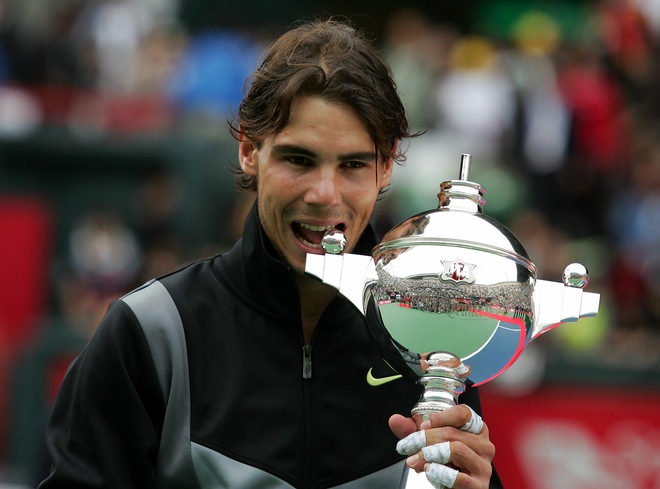
Nadal vs Monfils Tokyo 2010 Final
Rafael Nadal Wins Tokyo 2010 Finals- Match point & ceremony
Rafa Nadal: Heart of a Champion
My newest favoritie Rafa video


Victory knocks again at Rafa's door. Rafael Nadal defeats #15 Gael Monfils 6-1, 7-5. One of the very many things I love & respect about Rafa Nadal, is his tenacity, but above all his will, when he's not doing so well in a match like the one with Troicki he managed to pull though, another quality I love, that he rarely ever gets negative. We all witnessed yesterday how he struggled, clearly he wasn't haven't a great day, Rafa is a confidence player, for many of you that actually play tennis, we know & understand how difficult it is to maintain a certain level. Rafa clearly isnt superman he's a human being just like you or me, We as fans sometimes tend to overlook that, but that in the back of our minds & when he's missing, & not hitting well. We tend to freak out. I know I do.
Technically, Rafa played a solid match today, & Monfils to be honest just does not have the game to beat Rafa. Just my 2 cents ;)
Pics are taking their time incoming out so I'll post another after they're out.

Match Statistics:
| Nadal | Monfils | |
|---|---|---|
| Statistics on Serve | ||
| Aces | 1 | 9 |
| Double Faults | 1 | 0 |
| 1st Serve % | 61% | 85% |
| 1st Serve Points Won | 28/31 (90%) | 26/40 (65%) |
| 2nd Serve Points Won | 12/20 (60%) | 3/7 (43%) |
| Break Points Saved | 0/0 (%) | 1/4 (25%) |
| Service Games Played | 10 | 9 |
| Statistics on Return | ||
| 1st Return Points Won | 14/40 (35%) | 3/31 (10%) |
| Second Return Points Won | 4/7 (57%) | 8/20 (40%) |
| Break Points Won | 3/4 (75%) | 0/0 (%) |
| Return Games Played | 9 | 10 |
| Statistics on Points | ||
| Total Service Points Won | 40/51 (78%) | 29/47 (62%) |
| Total Return Points Won | 18/47 (38%) | 11/51 (22%) |
| Total Points Won | 58/98 (59%) | 40/98 (41%) |


Nadal To Face Monfils In Japan Open Final
"I played well in the first set, but then I lost my concentration," Nadal said, adding that his semifinal loss last week in the Thailand Open hurt his confidence. "The season is long and we compete with a lot of pressure, so it is easy to lose your concentration. That is what happened."
"I'm very motivated," he said. "I know it's going to be hard, but if I have a small opportunity I will take it."
Monfils, who was sidelined between March and May with an injury to his left hand, is ranked 15th in the world. He defeated No. 10-ranked Andy Roddick, the No. 2 seed, to get his place in the semifinals. That win broke an eight-match losing streak against top 10 opponents.
It also avenged a loss the last time he met Stepanek, in Brisbane in January. Monfils lost that match 6-2, 6-1.
"I had a shoulder problem then and I couldn't serve 100 percent," Monfils said. "But I came out today much stronger."
"I am playing better and better," Monfils said. "I change my game every day. Some days I'm defensive, some days I'm aggressive. Some times I'm on the net too much."
Nadal survives Troicki test to set up Tokyo final (1st Lead)
Rafael Nadal: The 'Dragon Ball' of tennis
While the former vegetarian Federer talked about Zen philosophy, Japanese proverbs, and playing tennis at the Imperial Palace, Nadal says stuff like “I don’t like shopping.”
On his off-day Wednesday, he played a few holes of golf but otherwise hung around the hotel trying to rest from a relentless year of touring which saw him win the French, Wimbledon and U.S. titles.
“Japan is one of the places you definitely want to know and hopefully I will be able to come back. The Japanese people are giving me a lot of presents. I’m just enjoying these days, on this very nice center court atmosphere,” he says.
Hungry Nadal looking for more glory at Japan Open
"It's difficult to change strategy in two days, but you can see how I was playing in Bangkok," he said. "If you see how I lost that match, it's difficult to say I have to change something. The only thing was maybe to play a little bit more aggressive.
"Every time when you arrive at a tournament you need time to adapt, and I've only had one day. I hope to be ready for tomorrow. It's important to be focused tomorrow, because Giraldo is a very good player and very dangerous."
Nadal blitzes Tursunov to keep Messi date
"I want to see Japan and Argentina after I have some dinner and rest," this year's triple grand slam winner said.
"I have some friends on the Argentina team. It will be an honour to see them and watch two good teams play.
"I still have lots of work to win this tournament but it would be very positive for me and a big boost for the rest of the season," added Nadal, making his debut in Japan.
Nadal Curbs Tursunov Resurgence
Hakuhou meets 'sumo grand champion of the tennis world' Nadal
“I played a good match, but he also made more mistakes after losing the first set,” assessed Nadal. “It's good for the confidence to keep winning after taking an important title like the US Open. When I go on court and I see a full stadium like here today, it is very nice. It is good for everyone.”
The sumo grand champion of annual wrestling matches, Hakuhou, was invited to the Ariake Colloseum - the venue of the Rakuten open tournament and he watched the match of Rafael Nadal, world #1.
He was invited by the Mongol tennis association. He performed the coin toss and had a handshake with Nadal.
In a meeting with the career grand slam champion and toast of this season, Hakuhou said "He is like the sumo grand champion of the tennis world. I have become a Nadal fan. I also won in 4 consecutive tournaments and having a series of victories. I want to work towards (doing well in) Kyushu too"

Rafa Defeated #54 Viktor Troicki 7-6(4), 4-6, 7-6(7). This match was a perfect example of how Rafa really needs to improve on this surface. He always struggles really hard during this time of year being that the indoor tournaments/surface is by far the toughest for him. Not to take away what Mr. Troicki had displayed, he played really aggressive & came to net enough times to break Rafa a few times, what you basically need to do vs. Rafa is shorten the points. SO.. all & all this is a prefect example of how much improvement Rafa still needs on this surface. He played well, & his improved serve really helped matters. But I fear against the big guys it still isnt enough. Rafa to me, might win this tomorrow in the final vs. Monfils. But in Shanghai or at the World Tour Finals. He needs to improve. I feel if Troicki had enough experience in the winning & bigger moments he might have won this match..But a W is a W..Rafa manages to squeeze into the finals! I'll take it!
We shall see tomorrow at the finals..
Stats:
| Nadal | Troicki | |
|---|---|---|
| Statistics on Serve | ||
| Aces | 18 | 26 |
| Double Faults | 3 | 4 |
| 1st Serve % | 62% | 70% |
| 1st Serve Points Won | 53/70 (76%) | 56/71 (79%) |
| 2nd Serve Points Won | 25/43 (58%) | 19/31 (61%) |
| Break Points Saved | 2/5 (40%) | 2/4 (50%) |
| Service Games Played | 17 | 17 |
| Statistics on Return | ||
| 1st Return Points Won | 15/71 (21%) | 17/70 (24%) |
| Second Return Points Won | 12/31 (39%) | 18/43 (42%) |
| Break Points Won | 2/4 (50%) | 3/5 (60%) |
| Return Games Played | 17 | 17 |
| Statistics on Points | ||
| Total Service Points Won | 78/113 (69%) | 75/102 (74%) |
| Total Return Points Won | 27/102 (26%) | 35/113 (31%) |
| Total Points Won | 105/215 (49%) | 110/215 (51%) |


